Free Trials and Refund Guarantees
Free trials and money-back guarantees are among the most common marketing tools used to introduce new products and services. In many industries, they are both reasonable and beneficial. They allow potential customers to experience a product before making a financial commitment, reducing uncertainty and helping them determine whether it meets their needs.
For products whose value lies primarily in their functionality – such as productivity software, streaming services, or design applications – a short trial can provide a meaningful representation of the user experience. If the software performs well today, there is generally a good reason to expect that it will perform similarly tomorrow.
However, this reasoning does not necessarily apply to every industry.
Not Every Product Can Be Evaluated the Same Way
Some products derive their value from stable and observable characteristics, while others depend heavily on external factors that constantly change.
Trading belongs to the second category.
The usefulness of a trading methodology, research platform, or analytical tool cannot be assessed independently of the market environment in which it is tested. Unlike conventional software, where functionality remains largely unchanged over time, the apparent effectiveness of a trading service can vary dramatically depending on prevailing market conditions.
As a result, a trial period that appears convincing may simply reflect a favorable market environment rather than the intrinsic quality of the underlying methodology.
Temporary Market Conditions Can Be Misleading
Financial markets periodically experience phases in which prices move with remarkable persistence. Strong bullish trends, prolonged bearish declines, or extended low-volatility environments can all create the impression that profitable trading is relatively straightforward.
During these periods, many different strategies may appear successful simply because the market itself provides a strong directional bias.
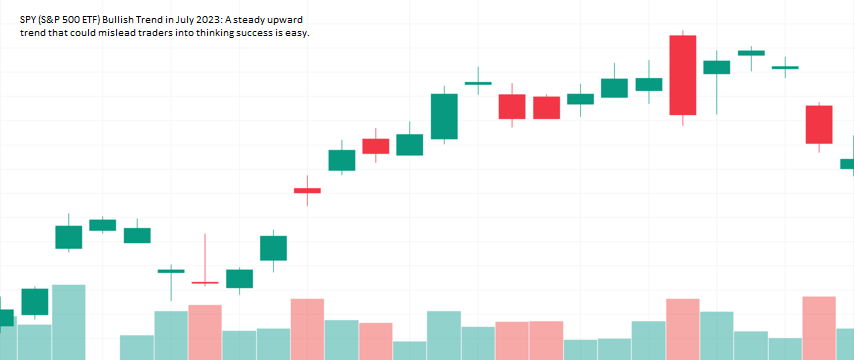
Consider the recent behavior of the S&P 500 ETF (SPY) in July 2023. During this period, the market experienced a steady upward trend, with prices rising consistently day after day. In such a scenario, nearly any strategy involving buying SPY would have been profitable.
It didn’t matter whether you bought at the open, the close, or somewhere in between; the overall upward bias meant that most trades would end up in the green. A free trial during such a period could easily convince a novice trader that they have found a winning strategy, or that the platform they are using is highly effective.
However, this impression is dangerously misleading. Market conditions like these are not the norm, and such linear trends rarely persist for long. Once the upward momentum stalls or reverses, the same strategy that seemed foolproof can quickly lead to losses. Traders who commit to a platform or strategy based on their experience during a linear uptrend may find themselves unprepared when market volatility returns.
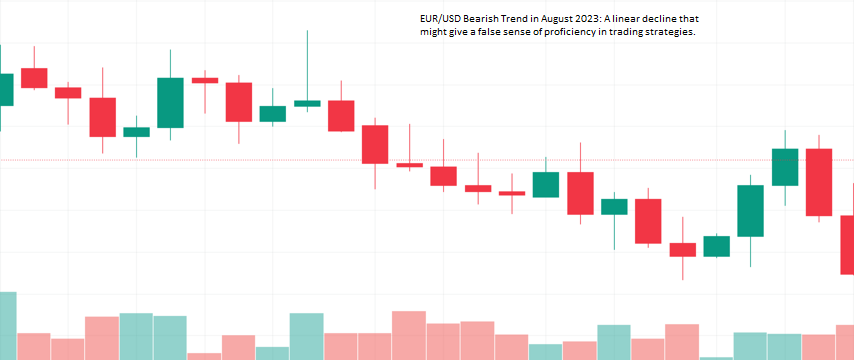
Another recent example can be seen in the EUR/USD currency pair during August 2023. In this period, the euro experienced a steady decline against the dollar (as shown in the second chart). Again, in such a linear downtrend, nearly any strategy that involved selling the euro to buy dollars would have been profitable.
The specific timing of the trade or the choice of indicators mattered little, as the persistent downward bias meant that most positions would close with a profit.
But, as with the SPY example, this downward trend was not permanent. When the conditions supporting the euro’s decline began to fade – whether due to changes in economic data, central bank policies, or broader market sentiment – those who had grown accustomed to easy profits found themselves exposed to sudden and significant losses.
A Short Trial Is Not a Statistical Validation
One of the most common mistakes is to confuse short-term performance with long-term robustness.
A trial lasting one or two weeks represents only a tiny fraction of the countless market environments that traders will eventually encounter. Bull markets, bear markets, sideways markets, periods of high volatility, low volatility, macroeconomic shocks, and unexpected events all require different characteristics from a trading methodology.
Drawing broad conclusions from such a limited sample is statistically unreliable.
The trial may demonstrate that the methodology worked under one specific set of market conditions, but it cannot establish that it will continue to perform consistently across future market regimes.
Research and Intellectual Property
Another important consideration is the nature of the product itself.
Many trading services are built upon years of quantitative research, data analysis, model development, and continuous refinement. In these cases, the primary value of the product does not lie in the software interface, but in the intellectual property embedded within the underlying methodology.
This creates a different commercial challenge.
Providing unrestricted access to proprietary research may allow competitors or experienced users to observe outputs over time, collect data, and potentially infer aspects of the underlying methodology through reverse engineering.
For this reason, organizations whose competitive advantage depends primarily on proprietary research often limit what can be accessed during evaluation periods. They may restrict historical data, delay signals, reduce available features, or avoid unrestricted trials altogether.
This should not be interpreted as evidence of superior quality, just as offering a free trial should not be interpreted as evidence of inferior quality. Rather, it reflects a trade-off between customer acquisition and the protection of intellectual property.
Marketing Incentives and User Expectations
Free trials and refund guarantees are, first and foremost, marketing tools.
Their objective is to reduce friction in the purchasing process and encourage potential customers to become paying users. There is nothing inherently wrong with this. In many industries, these approaches benefit both businesses and consumers.
However, in trading, there is an important distinction between evaluating a product and evaluating recent investment outcomes.
A user may finish a trial believing they have validated a profitable methodology, when in reality they have only experienced a favorable period in the market. The psychological impact of recent profits can easily outweigh a more objective assessment of the research process, risk management principles, or statistical robustness of the methodology.
The danger is not the trial itself, but the conclusions that users may draw from it.